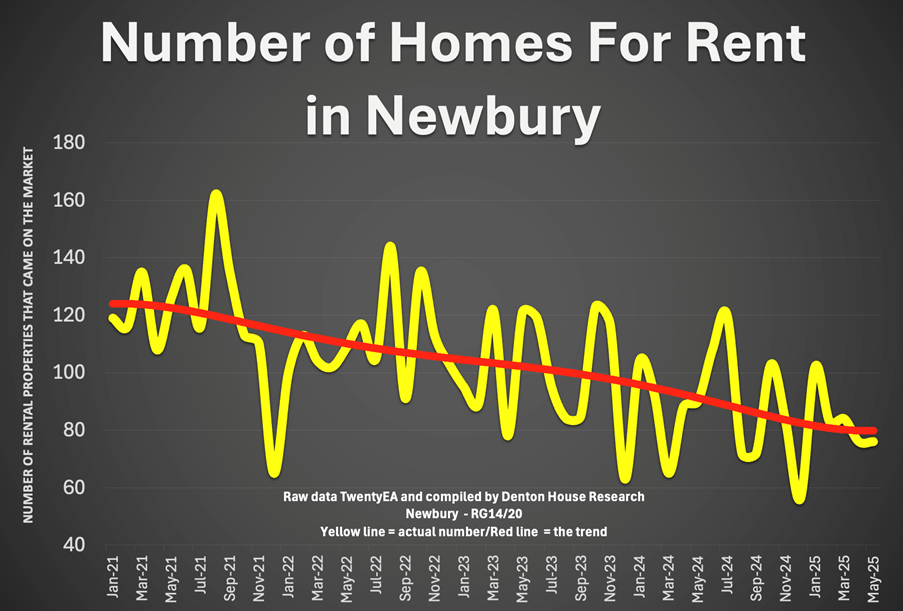
Over the last two years, the property market has been a rollercoaster ride of hyperactive demand, yet there are clouds on the horizon that suggest the property market could be at its peak.
Bank of England interest rates have increased four times in the last few months to try and combat inflation. Meanwhile many households are finding it tough to counter the most significant drop in real incomes in a single year since records began in the mid-1950s, all at the same time as gas, heating oil and electricity prices are predicted to rise again in the autumn.
Hence why some economists are predicting house price drops in the coming 18 to 24 months of around 3% to 5%.
So, surely this is not the best time to buy a Newbury property? Or is it?
I believe, subject to no significant shocks in the world economy, Newbury house price growth will be slow in the next 18/24 months and go into low single digits (even the odd month dipping ever so slightly into the red), but not the 16% to 19% annual drop we saw in 2008/9.
Every economist predicts growth in real household income in 2023/24 by around 1%.
If the two years are combined, the predicted effect on real household income in the next two years (2022/23/24) is a net loss of 1.4%, whilst in the credit crunch years 2010/11/12, the net loss was 2.7%.
Let us consider the increase in mortgage rates. 79% of owner-occupiers have fixed their mortgage costs and had their affordability stress-tested to Bank of England interest rates of 3% to 4% under the Mortgage Market Review rule changes in 2014. I believe the most significant impact of increasing interest rates will be at the point of taking on a new mortgage by first-time buyers (as opposed to servicing or the porting of an existing mortgage from one house to the next house).
The four successive Bank of England base rate rises, inflation and the rising cost of living are likely to bring more cautiousness over summer and autumn when it comes to people buying a property. Yet, there is still a massive imbalance of demand for property over the number of properties for sale to quench that demand.
The potency of the job market and the ongoing mismatch between the supply of properties on the market and demand for those properties will support property values.
Finally, the by-product of increasing inflation is that it makes buy-to-let more attractive. If there is a reduction in first-time buyers, this will be counterweighted by more landlords buying again, supporting the current level of Newbury properties.
But what if Newbury house prices do drop significantly?
So let’s assume that Newbury house prices do fall, irrespective of the reasons above. If we have a house price crash, people tend to find their careers are at risk, and their salaries don’t rise as much. The younger generation (i.e., first-time buyers age range) often gets hit the toughest by recessions.
If first-time buyers wait until 2024 to buy and Newbury property values drop by 10%, it could potentially prove more expensive, here’s why:
Mortgage deposits – the last 2008/09 crash, lenders weren’t offering 5% deposit mortgages. The lowest deposit mortgage that first-time buyers could get was with a 10% deposit and even then, they were hard to come by. writing this article, first-time buyers can obtain a 5% deposit mortgage for a fixed rate of 2.66% for five years.
So, if they were to buy now, based on a typical asking price for a terraced house in Newbury of £336,400 on this mortgage deal, the first-time buyer would have to stump up a £16,820 deposit and their mortgage payments would be £1,170.07 per month.
Yet, let’s say property values in Newbury do drop by 10% in the next 18 months, the same terraced house would now be worth £302,760, so a significant saving. Or is it?
Everyone believes interest rates will rise further, so let’s assume they go to 3% by the autumn of 2023. That means the mortgage rate for a 10% deposit mortgage will be in the early 5%’s, so let me assume 5.29% (because the banks tend to increase the gap between the base rate and the mortgage rate in recessions to allow for the extra risk).
The monthly mortgage payment on the 5.29% mortgage would be £1,426.00 per month, and you would need to double your deposit to £30,276.
So even if Newbury’s house prices did drop by 10%, the first-time buyer would be £3,070 worse off a year in mortgage payments and would have to find double the deposit, then there is the other cost of waiting. You have two years’ worth of rent to pay. The average rent for a Newbury property is £1,085 per month, you would spend £26,040 in rent.
Choosing to buy a property makes even more economic sense if it is a long-term choice, as homeowners can ride out any house price drops. Homeowners who plan to stay in a property can generally rely on getting their money back within six to ten years whilst not paying any rent.
Will Newbury prices go up, or will they go down?
Remember, George Osbourne said house prices would drop by 18% in May 2016 if we voted to leave the EU, whilst many economists said they would drop by 5% to 10% when Covid hit in March 2020 and we all know what happened!
If you think you will be better off owning your own Newbury home rather than renting one, don’t wait for the suggested house price drop that may never happen.
These are my thoughts, what are yours? Let me know in the comments.